

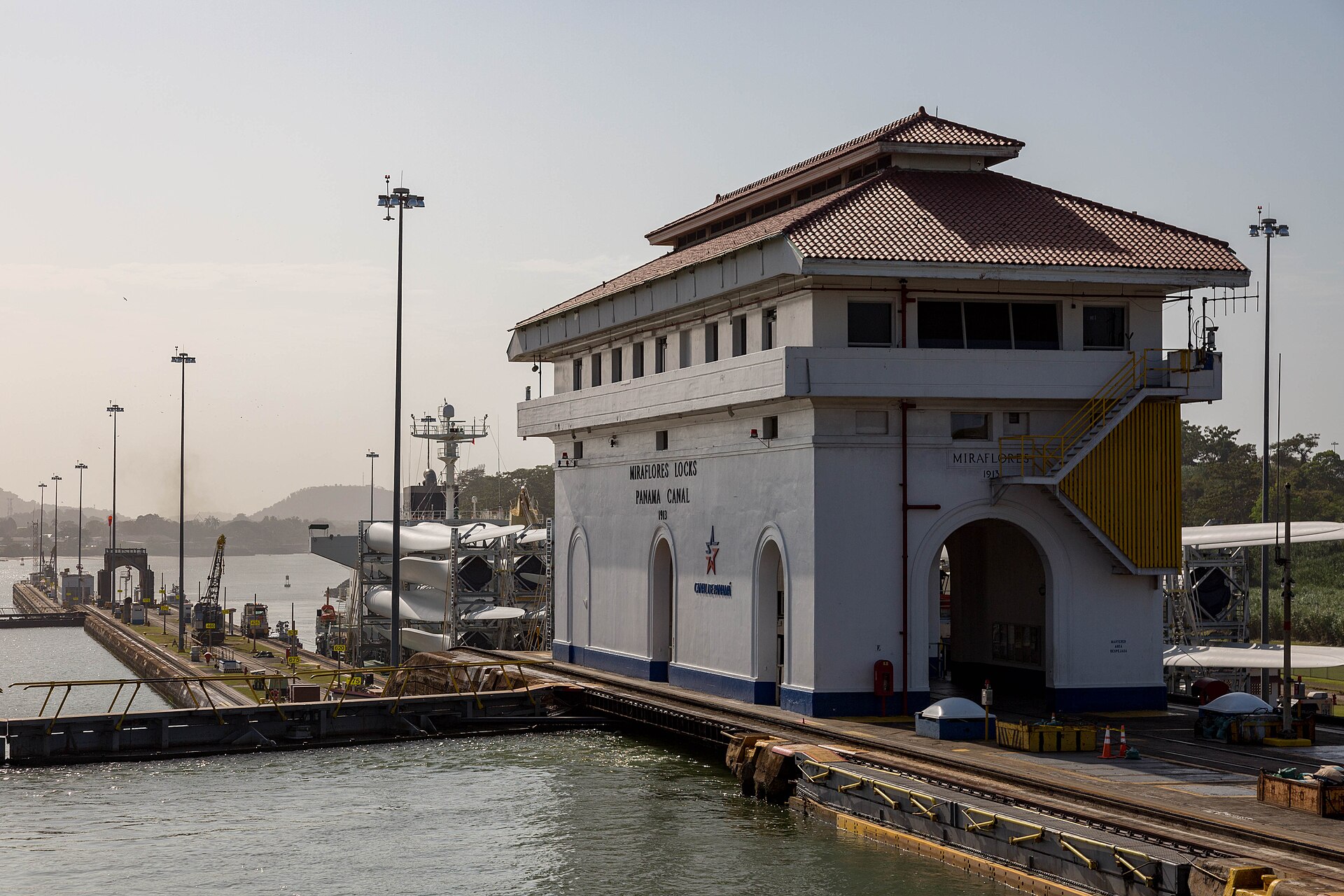
The Panama Canal took in about USD 6,600 million in fiscal year 2026, which closed on September 30: a record according to the Panama Canal Authority (ACP) and 16.6% more than the USD 5,705 million of the previous year, with 13,951 transits (+4.1%) and 521 million PC/UMS tons (+6.5%). Its budget projected a contribution of USD 3,193 million to the National Treasury. For someone buying an apartment it matters in two ways: it sustains the fiscal capacity behind the country’s investment grade, and it creates the logistics position that attracts the regional headquarters whose executives rent high-end housing. Its structural risk is a single one: water. Data verified as of November 20, 2026.
Almost all content about investing in Panama mentions the Canal and almost none quantifies it. This guide does so with the figures for the Canal’s fiscal year 2026, which runs from October to September and whose results were announced at the end of October 2026, and it answers the practical question: why does the Canal matter to you if what you are buying is an apartment? For the country’s general framework, see Panama for investors: the dollar, credit ratings and growth.
Sources: Panama Canal Authority, fiscal year 2026 results announced at the end of October 2026 (revenue preliminary and pending audit; the contribution is the budget projection, not the amount transferred). Data verified as of November 20, 2026.
A methodological warning, given by the Canal Authority itself: the revenue figures are preliminary and pending audit. The USD 3,193 million is the year’s budget projection, not the amount actually transferred to the Treasury, which we have not found. They are published this way because that is how they stand.
How much does the Canal contribute to the State, and why does it affect you?
The Canal’s direct contribution to the National Treasury is one of the central pieces of Panama’s public finances. For fiscal year 2026 the budget projected USD 3,193 million; for 2027, an S&P Global Ratings analysis cites a projection of USD 3,607.8 million in direct contributions, about USD 414 million more than the previous budget. Both are projections, not confirmed transfers.
| Fiscal year | Contribution | Nature of the figure |
|---|---|---|
| Fiscal year 2026 | USD 3,193 million | Budget projection; the amount transferred is not confirmed |
| Fiscal year 2027 | USD 3,607.8 million | Projection cited in an S&P analysis; about USD 414 million more than the previous budget |
Sources: Panama Canal Authority (fiscal year 2026 budget) · S&P Global Ratings (2027 projection). Data verified as of November 20, 2026.
The connection that almost nobody explains works as a chain. The Canal contributes between USD 3,200 and 3,600 million a year to the Treasury; that is a substantial part of the State’s fiscal capacity; that fiscal capacity is what two of the three major agencies weigh when they maintain the investment grade, and the investment grade underpins the country’s financing cost.
Translated for a property buyer: the Canal does not pay your rent, but it does sustain the framework in which you collect it. It is the underlying reason Panama can be a dollarized country, investment grade for two of three agencies and growing 4% to 5% (4.4% in 2025; 4.0% projected by Fitch and 5.0% by Moody’s for 2026), despite a narrow tax base. And it is also the reason the Canal’s risk is the country’s risk: there is no second engine of that size.
The Canal’s rating is better than the State’s
It is one of the most interesting and least cited facts. S&P rates the Panama Canal Authority BBB+ with a stable outlook, and the Republic of Panama BBB−. The difference is two notches. That comparison is our own arithmetic based on the two S&P ratings: none of the sources consulted states it explicitly.
| Entity and agency | Rating | Note |
|---|---|---|
| Canal Authority (S&P) | BBB+ | Stable outlook; maintained, with no new rating action |
| Republic of Panama (S&P) | BBB− | Investment grade, stable outlook |
| Republic of Panama (Moody’s) | Baa3 | Investment grade; outlook upgraded to stable in November 2026 |
| Republic of Panama (Fitch) | BB+ | One notch below investment grade; stable outlook |
Sources: S&P Global Ratings · Newsroom Panama (Moody’s) · Newsroom Panama (Fitch). The two-notch difference is our own calculation. Data verified as of November 20, 2026.
In the bulletin that accompanied the results, S&P clarified that this was not a new rating action but a confirmation. It attributed the strong year to greater water availability and higher demand for energy transport, and highlighted the financial margins and low level of debt. In a report dated November 14, 2026 it also projected that the Canal will keep its debt low despite its expansion plans.
For an investor, this is information on institutional quality: an autonomous authority, with its own rating above the sovereign’s and with margins and debt that an agency considers solid even taking into account an investment plan worth billions. How this fits with the country’s international tax position is explained in the guide on Panama as a tax jurisdiction in 2026 and the EU lists.
Where the 16.6% growth came from
- More water available. It is the first factor S&P cites. The previous year was constrained by drought.
- Energy segments. The increase in transits is attributed to energy vessels.
- Container ships. With a performance the sources describe as solid.
How to read the figure: if revenue rises 16.6% while transits rise 4.1% and tonnage 6.5%, revenue per transit grew faster than the number of transits. It is not only volume; price and vessel mix also play a part.
The Canal’s structural risk: water
The Canal’s capacity depends on the availability of fresh water. During droughts, draft has to be cut and, with it, the cargo per vessel. The Canal cut draft because of El Niño and, in response, accelerated the Rio Indio reservoir project, included in the investment plan for the coming decade. The Cabinet approved the Canal’s budget and declared the project a national priority.
- 01National priorityThe Cabinet approved the Canal’s budget and declared Rio Indio a national priority.
- 022027: awardThe aim is to award the main contract at some point in 2027.
- 032028: start of worksPhysical works are scheduled to start in 2028.
- 04Through 2034: resettlementThe ACP estimates the resettlement plan will continue through 2034.
Sources: Panama Canal Authority · Shipping Intelligence Hub. Aspirational timetable: works of this scale tend to run late. Data verified as of November 20, 2026.
The cost of the reservoir and associated works is a disputed figure: about USD 1,600 million according to one source and about USD 1,500 million according to another. Moody’s highlighted the Canal’s handling of El Niño and the importance of Rio Indio against future droughts; its analyst said the project can give the waterway “a lot of longevity.” S&P, as noted, projects low debt despite the expansion.
Sources: S&P Global Ratings · Newsroom Panama (Moody’s) · Panama Canal Authority. Data verified as of November 20, 2026.
For an investor with a five- to ten-year horizon, which is what the friction of buying and selling property in Panama imposes (see the real numbers of Panama real estate), the Rio Indio timetable falls within the holding period. It is not an argument for buying or for not buying: it is a public variable worth following.
The “Decade of Transformation”: USD 8,500 million in tenders
The Canal Authority declared 2026 the year of tenders for a USD 8,500 million program to turn the waterway into a diversified logistics and energy hub. It is the most concrete argument for an individual investor and it hardly appears in the content aimed at them.
| Project | Investment | Status |
|---|---|---|
| Corozal and Telfers container terminals | USD 2,600 million | Shortlisted bidders to be announced at the end of 2026; operation planned for 2029 |
| Energy corridor (gas pipeline) | USD 4,200 to 8,000 million; one source cites 2,000 (disputed) | Submission of prequalification documents closed in July 2026 |
| Rio Indio reservoir | USD 1,500 to 1,600 million (disputed) | Aims to secure operations against droughts for 50 years; tender details still limited |
| Hydropower associated with the dams | No published figure | Opportunities in repowering, energy efficiency and performance contracts for electromechanical equipment |
Sources: Shipping Intelligence Hub · BOE Report · Newsroom Panama · Icaza, González-Ruiz & Alemán. Data verified as of November 20, 2026.
The spin-off opportunities the sources cite are maritime services, value-added distribution centers (packaging, refrigeration, light assembly) and multimodal logistics into the region.
Why does this matter to a real estate investor and not just to a contractor? A USD 8,500 million program with terminals scheduled to operate in 2029 means, over a five- to ten-year holding period, demand for housing, offices and services along the Canal corridor. It is not a promise of appreciation: it is a public works timetable with identifiable counterparties. And to be honest: a range of 4,200 to 8,000 million for the energy corridor, with one source citing 2,000, varies by a factor of four; it is not a figure, it is the sign of a project at an early stage. The first verifiable milestone is the shortlist for Corozal and Telfers, to be announced at the end of 2026. If you are interested in the Colón side, see investing in Colón.
The ecosystem around the Canal, which is what actually rents your apartment
The Canal matters to a real estate investor because of what is built around it, not because of the tolls. That ecosystem includes the Colón Free Zone, which the sources consulted in November 2026 describe as the largest free zone in the Western Hemisphere; an international banking center; and the Multinational Company Headquarters (SEM) regime of Law 41 of August 24, 2007, with 192 headquarters as of May 2026, up from 186 in 2025, in technology, logistics, financial services and manufacturing. The details of those regimes are in the guide on investment incentives: SEM, EMMA and the Free Zone.
The full chain, in one go: the Canal creates the logistics position; the logistics position attracts regional headquarters; the headquarters bring expatriate executives, and those executives are the tenant who pays from USD 2,200 a month in Costa del Este, versus USD 900–1,700 for general central rents (Numbeo data). The series from 186 headquarters in 2025 to 192 in May 2026 is the only public indicator that directly measures that tenant. To go from rent to the yield in your own case, use the rental yield calculator and review the areas of Panama City.
What the Canal is not
| It is not… | Why it is worth saying |
|---|---|
| A dividend you collect | The contributions go to the National Treasury, not to residents or property owners |
| A guarantee of property appreciation | A home price to local income ratio of 14.7 and a local purchasing power index of 44.2 describe a market supported by foreign and corporate demand, not by the Canal’s GDP |
| A substitute for analyzing the asset | The Canal explains the framework; your apartment’s yield is explained by the maintenance fee, vacancy and management |
Sources: Numbeo, indices by country 2026 (base New York = 100). Data verified as of November 20, 2026.
That is why, before deciding, compare the apartment with its real alternative in the guide investing in Panama real estate as a foreigner and review the Panama real estate market.
What to confirm with your advisor
| Point | Status |
|---|---|
| Fiscal year 2026 revenue | Preliminary and pending audit, according to the ACP itself. The audited report is the definitive document |
| Contribution actually transferred to the Treasury in 2026 | Not found. The USD 3,193 million is a budget projection, not an outcome |
| Cost of the Rio Indio reservoir | Disputed: about USD 1,600 million according to one source and about 1,500 according to another |
| Two-notch difference between the Canal and the sovereign | Our own arithmetic based on the two S&P ratings; no source states it |
| Quantified effect of a drought on revenue | Not quantified here; it deserves its own tracking |
| Date of S&P’s latest action on the sovereign | Our reference is September 2026; confirm it at the source |
| Actual Rio Indio timetable | Aspirational: award “at some point in 2027” and start in 2028 |
| Energy corridor investment | A range of USD 4,200 to 8,000 million, with one source citing 2,000: early stage |
| Corozal and Telfers shortlist | To be announced at the end of 2026; the first verifiable milestone of the USD 8,500 million program |
Sources: Panama Canal Authority · S&P Global Ratings · BOE Report. Data verified as of November 20, 2026.
Frequently asked questions
How much revenue did the Panama Canal earn in fiscal year 2026?
About USD 6,600 million, a record according to the ACP and 16.6% more than the USD 5,705 million of the previous year. The figures are preliminary and pending audit. The fiscal year closed on September 30, 2026.
How many transits and how much tonnage did the Canal record in 2026?
13,951 transits, 4.1% more than the 13,404 of the previous year, and 521 million PC/UMS tons, 6.5% more. The growth was attributed to the energy segments and the solid performance of container ships.
How much does the Canal contribute to the Panamanian State?
The fiscal year 2026 budget projected contributions to the National Treasury of USD 3,193 million, and for 2027 an S&P analysis cites a projection of USD 3,607.8 million in direct contributions, about 414 million more. These are budget projections: the amount actually transferred in 2026 is not confirmed in the sources consulted.
What is the Panama Canal’s credit rating?
S&P Global Ratings kept the Canal Authority at BBB+ with a stable outlook, citing its financial margins and low debt, and clarified that this was not a new rating action. The Republic of Panama is rated BBB− by S&P, Baa3 by Moody’s and BB+ by Fitch.
What is the Canal’s structural risk?
Water. Capacity depends on the availability of fresh water and, in a drought, draft has to be cut. The Canal did so because of El Niño and accelerated the Rio Indio reservoir: an estimated cost of USD 1,500 to 1,600 million depending on the source, a declared national priority, an award planned for 2027, works from 2028 and resettlement through 2034.
What is the Canal’s Decade of Transformation?
A USD 8,500 million tender program, with 2026 declared the year of tenders, to turn the waterway into a diversified logistics and energy hub. It includes the Corozal and Telfers terminals (USD 2,600 million, operation planned for 2029), an energy corridor of USD 4,200 to 8,000 million depending on the source (one cites 2,000), the Rio Indio reservoir and the hydropower associated with the dams.
Sources
- Panama Canal Authority: fiscal year 2026 results (end of October 2026) and the year’s budget.
- S&P Global Ratings: confirmation of the ACP’s BBB+ rating and report of November 14, 2026.
- Shipping Intelligence Hub: 2026, the year of tenders for the USD 8,500 million program
- BOE Report: terminal shortlist before year-end
- Newsroom Panama: gas pipeline document submission closes
- Icaza, González-Ruiz & Alemán: investment in the Panama Canal
- Newsroom Panama: Moody’s improves Panama’s outlook (November 2026)
- Newsroom Panama: Fitch affirms Panama at BB+
- The Rio Times: 192 multinational company headquarters
- Numbeo: indices by country 2026
Disclaimer: this is general information, not legal, tax or financial advice. Canal figures are preliminary or budgetary where indicated, and construction timetables may change. Consult a licensed advisor in Panama before investing.

Milan Valdés Báez is an independent journalist and researcher based in Panama and the editor of Invest in Panama Real Estate, the real estate investment guide for foreigners. Every figure on the site is checked against official sources (the Official Gazette, the Superintendency of Banks, INEC, the National Migration Service and the Public Registry), with notes on which data have changed and which circulate out of date, and the guides and calculators are kept current. ORCID iD: 0009-0000-0112-3529.