

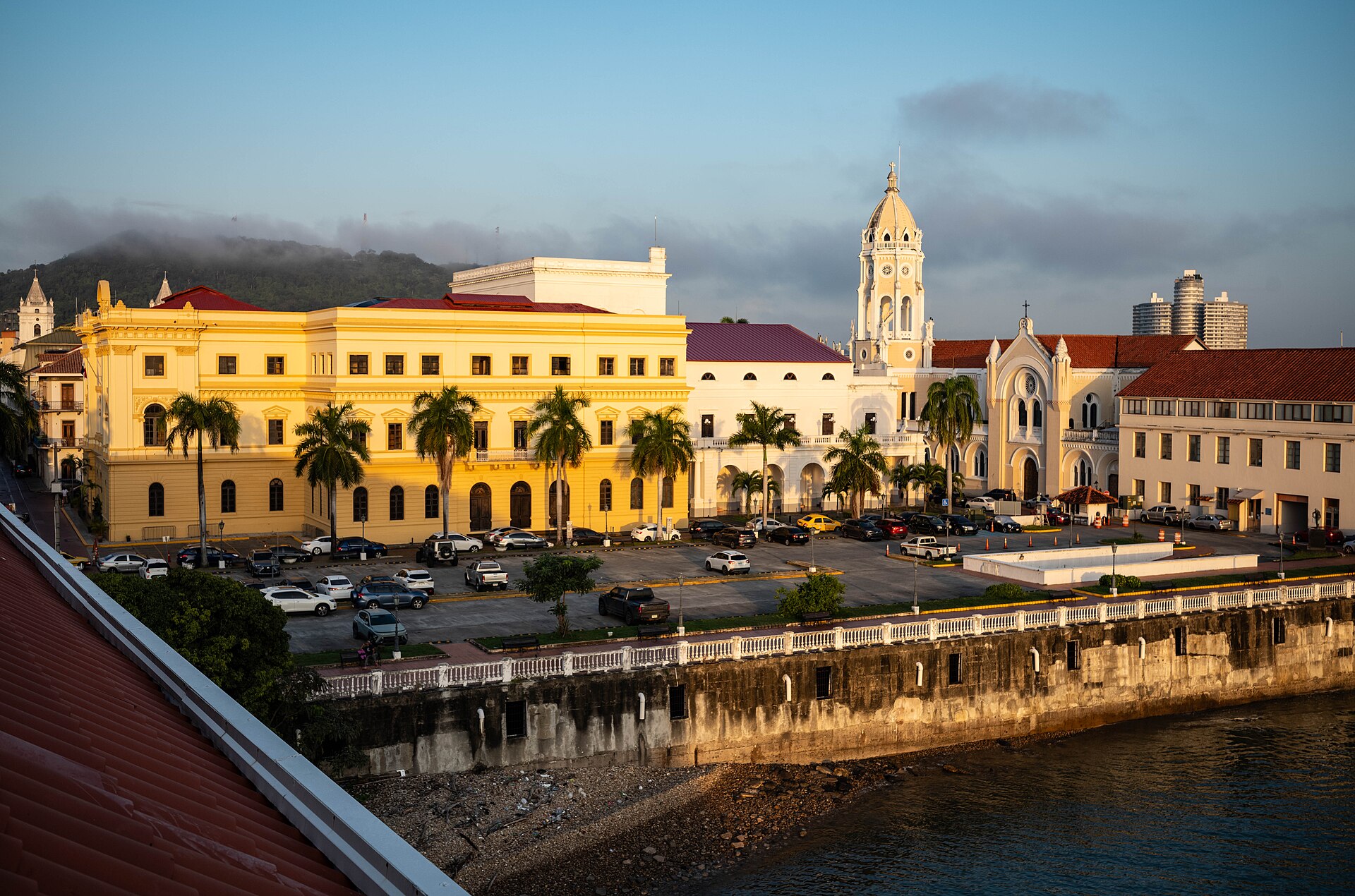
Panama guarantees foreign investors the same rights as its own nationals: article 2 of Law 54 of July 22, 1998 says so, and it also guarantees the free repatriation of capital, dividends, interest and profits. The same law offers anyone who invests at least B/.2,000,000 in a productive activity and registers with the Ministry of Commerce and Industries ten years of legal, national tax, municipal tax, customs and labor stability, with indirect taxes excluded. And there are two limits that no statute can override because they sit in the Constitution: article 291 bars foreigners, and Panamanian companies with foreign capital in whole or in part, from acquiring land within ten kilometers of the borders, and it places conditions on the sale of island territory. This guide explains both sides with the official text in hand. Data verified as of November 22, 2026.
Notice: this guide describes Panamanian rules as read in their official text. It is not legal advice. To use any of these regimes you need a Panamanian lawyer; what follows helps you know what to ask.
Law 54 of 1998: the law almost nobody cites by number
Sales pages keep repeating that Panama “treats foreign investors the same as locals.” That is true, and there is a law behind it: Law 54 of July 22, 1998, “which enacts measures for the legal stability of investments,” passed by the Legislative Assembly. One secondary source dates it July 24; the official PDF published by the MICI says July 22, 1998. If someone quotes you the 24th, they are copying a summary.
| Item | Detail |
|---|---|
| Statute | Law 54 of July 22, 1998 |
| Regulations | Executive Decree 9 of 1999 (its text was not verified as of this date) |
| Authority | Ministry of Commerce and Industries (MICI), art. 6; the register is kept by DINADE |
| Adding activities | The Cabinet Council may add activities on the MICI’s recommendation (art. 5) |
| Art. 1 | The State promotes and protects investments aimed at the effective production of goods and services |
| Art. 2 | The same rights and obligations as nationals; freedom of trade, industry, export and import; free repatriation of capital, dividends, interest and profits |
| Art. 3 | A foreigner’s property right has no limits other than the Constitution and the law |
| Art. 4 | A foreigner’s intellectual and industrial property follows the same rules as a national’s |
Sources: MICI, official text of Law 54 of 1998. Data verified as of November 22, 2026.
Notice the phrase that articles 2 and 3 repeat: “with no limitations other than those established in the Political Constitution and the Law.” The law recognizes equality and, in the same line, defers to the Constitution, which sets two specific limits. You will see them below.
The five stability guarantees of article 10
Article 10 grants five guarantees for a term of ten years. Each has its own scope and its own exception:
- 01Legal stabilityNew provisions will not affect your founding regime, except for reasons of public utility or social interest.
- 02National tax stabilityYou remain subject only to the regime in force on the date of your registration with the MICI. Indirect taxes are excluded.
- 03Municipal tax stabilityChanges in municipal taxes can only affect you every five years.
- 04Customs regimesTax refunds, exemptions, temporary admission and similar regimes. The Cabinet Council’s power to change tariffs does not breach this guarantee.
- 05Labor regimeThe provisions in force at the time of hiring, under Panamanian law and international conventions.
Sources: Law 54 of 1998, art. 10. Data verified as of November 22, 2026.
The two nuances that rarely get published
First: indirect taxes are left out. Item 2 puts it this way: “Indirect taxes are understood to be excluded from the tax stability provided for in this item.” In other words, the ITBMS can go up and the guarantee does not protect you. Anyone who promises you “ten years of frozen taxes” without this sentence is telling you half the story. See how that tax works in the ITBMS explained.
Second: the exception in item 1 (“except for reasons of public utility or social interest”) matches word for word the one article 48 of the Constitution uses for expropriation. That is our own comparative reading, not a quote from another source: the ten-year stability and the constitutional guarantee of property share the same exit door. Law 54 could not shield more than the Constitution shields. How far that standard reaches in practice is illustrated by the Cobre Panama case, although that case applied a different constitutional provision to a concession, not article 10.1 of this law.
If the tax regime changes while you are inside
| Scenario | Consequence |
|---|---|
| An exemption expires or a national tax is modified | You are taxed under the regime in force when you registered with DINADE, except for public utility or social interest |
| A tax is repealed and replaced by another | You pay the new one, but never more each year than you would have paid under the repealed tax |
| You want to leave the frozen regime | You may opt once for the applicable tax regime (art. 13); the decision is irreversible |
Sources: Law 54 of 1998, arts. 12 and 13. Data verified as of November 22, 2026.
The article 13 option is a decision to make with a tax advisor, not with the project’s developer.
The filter: two million balboas in a productive activity
| Requirement | Detail |
|---|---|
| Minimum amount | B/.2,000,000 (the balboa is at par with the US dollar) |
| Execution period | Whatever the law governing the activity sets or, failing that, a maximum of 2 years from registration; DINADE may extend it |
| Proof | Sworn statement by the investor, certification by a licensed public accountant and supporting annexes |
| Investment plan | Investor’s details; for a legal entity, articles of incorporation and a Public Registry certificate no more than 2 months old; the activity, with feasibility studies and plans; the amount; the number of projected jobs |
| Ongoing obligations | Maintain the investment according to the plan and comply with environmental rules |
Sources: Law 54 of 1998, art. 16. Data verified as of November 22, 2026.
The conclusion is clear: this regime is not a residency-by-investment route. It is a stability regime for productive projects, with a threshold ten times that of Friendly Nations (Países Amigos, B/.200,000) and a little over six times that of the Qualified Investor route for new construction (B/.300,000). It serves someone building a hotel, a plant, an agribusiness, a port, power generation or a forestry project; not someone buying an apartment to rent it out. The immigration routes are covered in Panama’s residency options.
Which activities qualify and who is left out
Article 5 lists: tourism, industry, agriculture, exports, agroforestry, mining, export processing zones, commercial and oil free zones, telecommunications, construction, port and railway developments, power generation, irrigation projects and efficient use of water resources, and any activity the Cabinet Council approves. How much that list has grown since 1998 has not been verified as of this date.
Article 9 excludes anyone with a final court conviction, Panamanian or foreign, for tax or customs offenses, or with liquid, enforceable and unpaid tax debts, as well as anyone convicted of drug offenses, money laundering, fraud, misappropriation or forgery of documents. If the investor falls into any of those grounds after registering, the registration is canceled and all benefits are extinguished.
The two constitutional limits: borders and islands
Article 291 of the 1972 Political Constitution, with amendments through 2004, reads: “Foreign natural or legal persons, and national ones whose capital is foreign in whole or in part, may not acquire ownership of national or private land located less than ten kilometers from the borders.” On islands: “Island territory may only be transferred for specific purposes of the country’s development,” provided it is not a strategic area or one reserved for government programs, and that it is declared a special development area with legislation on its use, safeguarding National Security.
Sources: Political Constitution of Panama, arts. 290 and 291. Data verified as of November 22, 2026.
This limit matters most for parcels in Chiriquí and Bocas del Toro near Costa Rica and for island projects. If that area interests you, also read buying in Bocas del Toro and possession rights and land. Before visiting a parcel, its folio real (registry folio) number already tells you its district: see how to verify a title at the Public Registry.
What the Constitution does guarantee, with its exception
| Article | Content |
|---|---|
| Art. 47 | Private property lawfully acquired by legal or natural persons is guaranteed, with no distinction by nationality |
| Art. 48 | Property has a social function; for public utility or social interest defined by law, expropriation is possible through a special proceeding and compensation |
| Art. 50 | When it conflicts with a law of public utility or social interest, private interest must yield |
| Art. 51 | In war, serious disturbance of public order or urgent social interest, the Executive may expropriate or occupy; “The State is always liable for any expropriation” and will pay its value |
| Art. 52 | No one is required to pay a contribution or tax that is not legally established |
| Art. 310 | “The Republic of Panama shall have no army”; the law organizes the police services |
Sources: Political Constitution of Panama. Data verified as of November 22, 2026.
The framework is favorable: Panama guarantees property regardless of nationality, requires a court proceeding and compensation to expropriate, and declares itself always liable, even in an emergency expropriation. The public utility or social interest exception is broad, but it is not a Panamanian peculiarity: it appears in most civil-law constitutions. It is the real perimeter of the right. For a buyer’s day-to-day protections, see property buyer protections in Panama.
How a dispute with the State is resolved: article 20
- 01Mandatory conciliationDisputes over the application, enforcement or interpretation of the law are first settled by conciliation, under the rules of the Panama Conciliation and Arbitration Center.
- 0230 business daysCounted from the effective filing of the request.
- 03The investor’s choiceIf there is no solution, the investor may go to the competent administrative or judicial authority, or to arbitration at the same Center.
- 04Final award“Arbitral awards shall be final and binding”; they are enforced under national law, except on grounds of procedural cassation or annulment.
Sources: Law 54 of 1998, art. 20. Data verified as of November 22, 2026.
The exclusion worth reading twice: conciliation and arbitration do not cover “the audit actions of the national and municipal tax administrations, and the administrative acts of interpretation and collection of taxes.” You can take the State to arbitration for breaching the stability regime, but not a tax audit or a DGI assessment, which go through Panama’s administrative and judicial channels. Moreover, the Law 54 forum is domestic. If you want an international forum, what you need is an investment treaty with your country: see Panama’s bilateral investment treaties.
What Law 54 is not
| It is not… | Because… |
|---|---|
| A residency route | It grants no immigration permits. For that there are ED 16 of 2026 (Friendly Nations), ED 17 of 2026 (Qualified Investor), art. 191 of ED 320 of 2008 and ED 199 of 2021 |
| A tax exemption | It freezes the regime in force; it does not lower it. The incentives are in SEM (Law 41 of 2007), EMMA (Law 159 of 2020) and the Free Zone |
| Applicable to buying a home | It requires a productive investment under art. 5, B/.2,000,000 and a jobs plan |
| A shield against the tax authority | Art. 20 excludes tax audits and tax collection |
| Automatic | It requires registration with DINADE, an approved plan and later proof |
Sources: Law 54 of 1998 · Executive Decree 17 of 2026. Data verified as of November 22, 2026.
The tax incentives are explained in SEM, EMMA and the Free Zone, and if your goal is residency, the “Which Panama visa is right for me?” tool points you in the right direction in a minute.
What to confirm with your advisor
| Question | Verifiable answer |
|---|---|
| What is the legal stability law, with number and date? | Law 54 of July 22, 1998, regulated by ED 9 of 1999 |
| How much must be invested and over what period? | B/.2,000,000 within a maximum of 2 years from registration (art. 16), extendable by DINADE |
| Does the stability cover the ITBMS? | No: art. 10.2 excludes indirect taxes |
| Can I buy a parcel 5 km from the border through a Panamanian company? | No: art. 291 reaches companies with foreign capital in whole or in part |
| Can I take a DGI assessment to arbitration? | No: art. 20 excludes tax audits and tax collection |
Sources: Law 54 of 1998 · Political Constitution. Data verified as of November 22, 2026.
Not verified as of this date: the text of Executive Decree 9 of 1999, how many investors are registered with DINADE, and whether there is case law on the scope of the article 10.1 exception. For the general buying framework, go back to can a foreigner buy property in Panama? or to the Panama real estate law section.
Frequently asked questions
Which law protects foreign investment in Panama?
Law 54 of July 22, 1998, regulated by Executive Decree 9 of 1999. Its article 2 gives foreign investors the same rights and obligations as nationals, with no limits other than the Constitution and the law, and includes the free repatriation of capital, dividends, interest and profits. The authority is the MICI and the register is kept by DINADE.
What exactly does the legal stability regime guarantee?
Five stability guarantees for ten years (art. 10): legal, except for public utility or social interest; national tax, under the regime in force at registration with indirect taxes excluded; municipal, with changes only every five years; customs; and labor, under the rules in force at the time of hiring.
How much do you have to invest to qualify?
B/.2,000,000 (art. 16), executed within the period set by the law governing the activity or, failing that, within a maximum of two years from registration, extendable by DINADE. It is proven with a sworn statement, a licensed public accountant’s certification and annexes, and the plan must state the projected jobs.
Can Law 54 be used to obtain residency?
No. It is a regime for productive projects. The residency-by-investment routes are ED 16 of 2026 (Friendly Nations), ED 17 of 2026 (Qualified Investor), art. 191 of ED 320 of 2008 (Own Economic Solvency) and ED 199 of 2021 (forestry investor).
Can a foreigner buy land anywhere in Panama?
No. Article 291 of the Constitution bars foreigners, and national companies with foreign capital in whole or in part, from acquiring national or private land within ten kilometers of the borders; a local company does not avoid it. Island territory may only be sold for development purposes, if it is not a strategic area and if it has been declared a special development area with its own legislation.
How is a dispute between an investor and the Panamanian State resolved?
Under article 20 of Law 54: first conciliation before the Panama Conciliation and Arbitration Center; if there is no solution within 30 business days, the investor chooses between the administrative or judicial route and arbitration at the same Center, with final and binding awards. Tax audits and tax collection are excluded.
Does Panama have an army?
No. Article 310 of the Constitution states that “The Republic of Panama shall have no army” and leaves the organization of the police services to the law. It is a point of institutional stability that rarely appears in material for investors.
Sources
- Law 54 of July 22, 1998, official text (MICI): arts. 1 to 13, 16 and 20
- Political Constitution of Panama of 1972 with amendments through 2004: arts. 46 to 53, 290, 291 and 310
- Executive Decree 17 of 2026, Qualified Investor (National Migration Service, SNM)
- Executive Decree 9 of 1999, regulations of Law 54 (cited; text not verified as of this date)
Notice: this is general information, not legal, tax or financial advice. The rules cited may change or have regulatory developments not covered here. Consult a lawyer licensed in Panama before using any regime or buying a property.

Milan Valdés Báez is an independent journalist and researcher based in Panama and the editor of Invest in Panama Real Estate, the real estate investment guide for foreigners. Every figure on the site is checked against official sources (the Official Gazette, the Superintendency of Banks, INEC, the National Migration Service and the Public Registry), with notes on which data have changed and which circulate out of date, and the guides and calculators are kept current. ORCID iD: 0009-0000-0112-3529.