

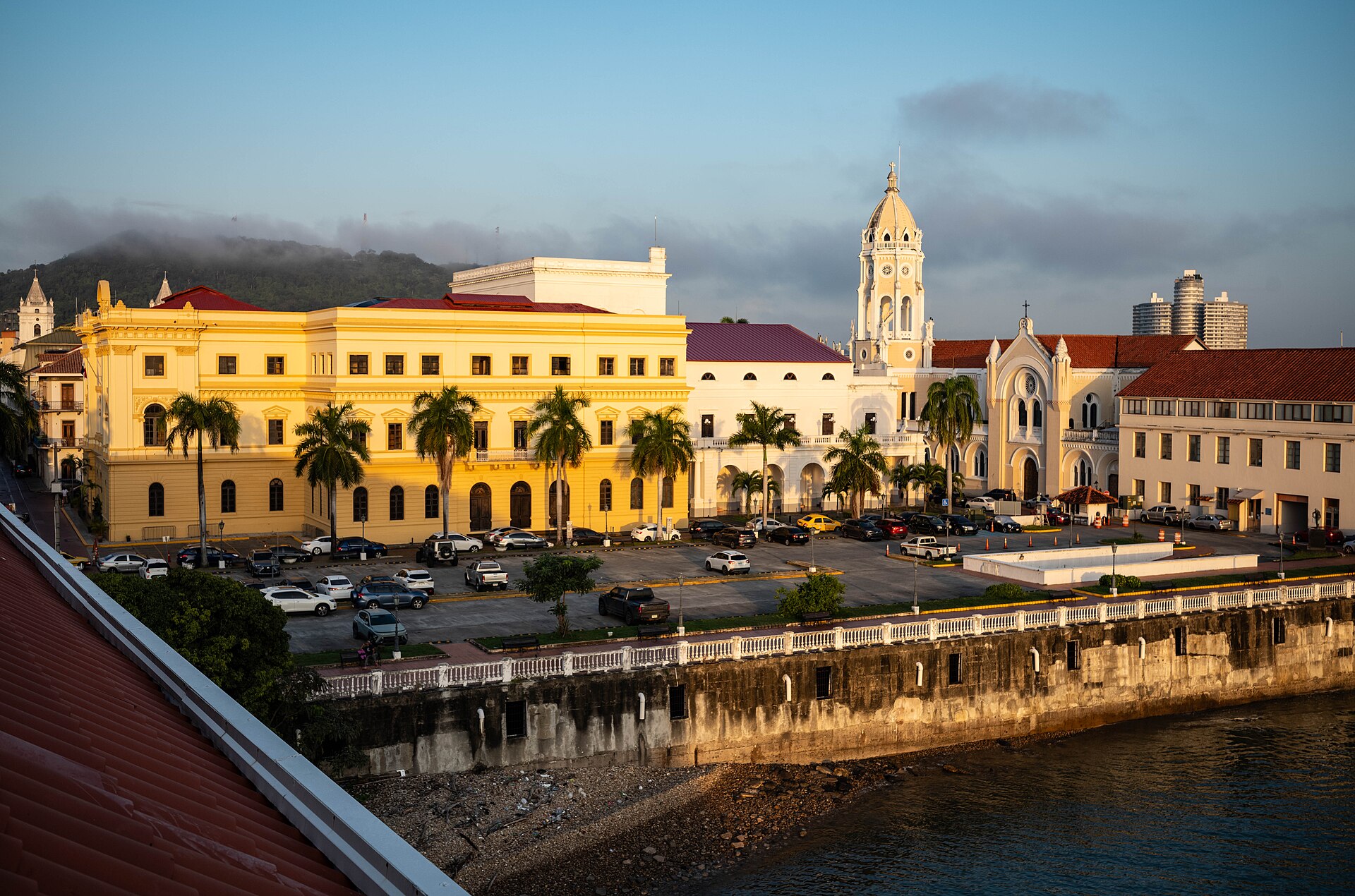
Casco Antiguo is the only real estate market in Panama with a tax regime of its own: Law 136 of December 31, 2013 (Official Gazette 27455-A, published on January 17, 2014, 52 articles). It grants thirty years without property tax on the land and declared improvements to restored buildings that obtain their occupancy permit after the law took effect (art. 19), ten years without income tax on profits from commercial activity, sale or transfer (art. 18), an exemption from transfer tax on the first sale with a minimum investment of B/.50,000 (art. 20), an import duty exemption for equipment and materials (art. 21) and a rent deduction for residential tenants for five years (art. 22). The counterpart is in the same text: an owner who does not work on the property can be penalized (art. 31). Data verified as of November 22, 2026.
The guide to investing in Panama City places Casco Antiguo on the map of the capital (World Heritage Site, Law 91 of 1976, 2001 Master Plan) and notes that its sources did not detail the amounts in Law 136. This guide does exactly that: it reads the regime article by article, with what it gives and what it demands.
What the law is and where it comes from
| Item | Detail |
|---|---|
| Title | Que actualiza el régimen fiscal aplicable para la rehabilitación y puesta en valor del Conjunto Monumental Histórico del Casco Antiguo de la ciudad de Panamá (updating the tax regime for the rehabilitation and enhancement of the Historic Monumental Complex of Casco Antiguo) |
| Official Gazette | 27455-A, published on January 17, 2014; 11 pages |
| Origin | Bill 433 of 2012, approved in third reading on December 12, 2013 |
| In force | From its promulgation (art. 52) |
| What it amends | Arts. 34 and 35 of Decree-Law 9 of 1997 (art. 51) |
| Chain of rules | Decree-Law 9 of 1997, amended by Law 4 of January 15, 2002 and updated by Law 136 of 2013 |
Sources: Official Gazette 27455-A · record of the law in Legispan (National Assembly) · list of rules of the Ministry of Culture. Data verified as of November 22, 2026.
One disputed detail is worth keeping in mind if you are going to cite the original rule: art. 51 of Law 136 dates Decree-Law 9 to August 27, 1997, while several secondary sources date it to August 30. The text of Decree-Law 9 could not be read (the available PDF is a scanned image); check the date in the Gazette before citing it. What matters for the investor is something else: the regime has almost three decades of legislative continuity, which weighs more than the generosity of any of its benefits.
The incentives for owners, article by article
| Incentive | Scope | Article |
|---|---|---|
| Property tax | 30-year exemption on the land and declared improvements, for buildings constructed, reconstructed or restored that obtain their occupancy permit after the law took effect | 19 |
| Income tax | 10-year exemption on profits from commercial activities, sale or transfer of part or all of the property, counted from the occupancy permit | 18 |
| Transfer tax | The first transfer after the law took effect is exempt, for part or all of a restored or constructed building or lot, with a minimum investment of B/.50,000 | 20 |
| Import duty | Exemption for construction and fit-out equipment and materials not produced in the country in sufficient quantity and quality and not intended for sale to the public; requires certification from the National Directorate of Historic Heritage | 21 |
| Parking | 10-year income tax exemption on profits from using fourth-order buildings or vacant lots as public parking | 23 |
| Donations | Donations for parks, walls, green areas, churches and other public sites in the complex are a deductible expense for income tax | 17 |
Sources: Law 136 of 2013, Official Gazette 27455-A. Data verified as of November 22, 2026.
Put in order, the combination is unusual. The thirty years of art. 19 are the longest-lasting benefit we have documented in Panama, and the article sets no investment threshold. The ten years of art. 18 also cover the sale: you not only stop paying property tax while you hold the asset, but the capital gain on the sale is exempt for ten years from the occupancy permit. For someone who buys, restores and sells, that is the core benefit.
Two literal limits of art. 19. First, the exemption is for whoever obtains the occupancy permit after the law took effect: the benefit arises with the restoration, not with the purchase of something already restored. Whether it passes to a later buyer depends on the regulations, which have not been located to date; this is decisive for the resale market and you should confirm it before paying a price that includes it. Second, the article refers to “the declared improvements”: an undeclared improvement is an unexempted improvement. To estimate what you would pay without the regime, use the property tax calculator.
Sources: Law 136 of 2013. Data verified as of November 22, 2026.
The tenant deduction: a subsidy for rental demand
Art. 22 provides that tenants of a constructed, reconstructed or restored building in Casco Antiguo “that is intended for housing may deduct from their gross income or general income the rent they pay” during the first five years from the occupancy permit. We have not found any other Panamanian regime with an equivalent incentive.
For anyone buying to rent, the consequence is direct: a tenant who deducts the rent from income tax can afford more for the same net outlay. It is residential rental demand supported by law for five years from the occupancy permit, and the treasury pays for it. The limit is also in the text: it applies to housing, not to commercial premises. Remember too that Casco Antiguo is in the district of Panamá, where art. 21 of Law 80 of 2012 prohibits renting for less than 45 days without a tourism permit: the model this incentive favors is long-term rental. Compare scenarios in the rental yield calculator and read the lease agreement in Panama.
The preferential mortgage loan: how it works
Arts. 2 to 6 set up a mechanism in which the benefit goes not to the buyer but to the bank, and reaches the buyer as a lower interest rate.
| Item | Detail | Article |
|---|---|---|
| Who can grant them | Private banks, Caja de Ahorros, Banco Nacional, Banco Hipotecario Nacional, financial institutions and savings and loan associations, after registering with the Ministry of Economy and Finance | 2 |
| Purpose | Exclusively to restore, reconstruct or build, or to buy an already restored property, in Casco Antiguo and its adjacent or transition area | 3.1 |
| Plans | Approved in advance by the National Directorate of Historic Heritage | 3.2 |
| Collateral | Mortgage on the property, with its location certified by Historic Heritage; replaceable by other properties at the bank’s discretion | 3.3 |
| Reference rate | Published by the Superintendency of Banks (SBP), with Caja de Ahorros and the five private banks with the largest portfolios, on first mortgages of 15 years or more | 4 |
| Preferential tranche | Difference between the reference rate and the rate the bank charges; it cannot exceed three percentage points, whatever the amount | 5 |
| Compensation to the bank | Annual tax credit against its income tax, over the original life of the loan | 6 |
| Term | No minimum or maximum term; subject to bank policies | 4 |
Sources: Law 136 of 2013. The current reference rate and the list of institutions registered with the MEF have not been verified to date. Data verified as of November 22, 2026.
Three practical consequences. First, the cap has a number. If the reference rate were, for example, 7%, the preferential loan could go as low as 4% (an illustrative example, not a current rate). Second, the loan can also be used to buy an already restored property, not only to restore, which greatly widens the eligible transactions. Third, eligibility passes twice through the National Directorate of Historic Heritage, with the plans and with the location certification; that office, not the bank, sets the timetable. Ask each bank whether it is registered to offer this product and compare it with the general market in the mortgage comparison tool and in the guide to mortgages for foreigners.
One detail worth checking before you apply: art. 4 mentions registration with the “National Public Revenue Authority” (Autoridad Nacional de Ingresos Públicos). Today tax procedures are handled by the General Revenue Directorate (DGI); which office that registration now belongs to has not been verified to date, and your adviser should confirm it.
The duty to restore and the penalty procedure
Art. 31 provides that the owner of any property or vacant lot in Casco Antiguo “that is not worked on or, failing that, restored, reconstructed or adapted” to the standards of the Historic Monumental Complex will be subject to administrative penalties. The procedure has defined deadlines:
- 01InvestigationThe National Directorate of Historic Heritage acts on its own initiative or upon a complaint; the resolution ordering the investigation cannot be appealed (art. 40).
- 02Investigation periodNo more than 30 business days, extendable only once for justified cause (art. 40).
- 03Decision30 days from the owner’s response, if there is no evidence to be taken (art. 44).
- 04AppealsReconsideration or appeal before Historic Heritage or the General Directorate of the National Institute of Culture, decided in no more than 30 days (art. 48).
Sources: Law 136 of 2013, arts. 31, 40, 44 and 48. The amount of the penalties has not been verified to date. Data verified as of November 22, 2026.
This reverses the usual logic. In any other Panamanian market, leaving a property idle is the owner’s decision; in Casco Antiguo it is an administrative offense with a procedure and deadlines. Buying a ruined house to wait for it to appreciate is not a strategy: it means taking on a case file. The regime is consistent, though demanding: it gives thirty years without property tax to whoever restores and penalizes whoever does not. Anyone who only reads the part about the thirty years goes in badly. The amount of the penalties has not been verified to date: ask about it before buying a property that has not been worked on.
Occupants: the article you need to read in full
Art. 24 instructs the Executive Branch, through MIVIOT, to relocate non-owners occupying buildings whose restoration or full reconstruction project has preliminary plans approved by Historic Heritage and by Municipal Works and Construction. The government, with the Banco Hipotecario Nacional, must study the corresponding housing projects, taking into account the socioeconomic interest of the tenants and respecting property rights. And the final sentence says: “Eviction shall not be conditional on the obligation of the Ministry of Housing and Land Planning to relocate the tenant or occupant.”
Put plainly: the law orders relocation and, at the same time, decouples eviction from that obligation, so eviction can happen even if relocation has not taken place. The Panamanian press has described Casco Antiguo as a story of abandonment and gentrification, and this article is the mechanism behind that reading. It matters to the investor for two reasons: it is the real social context of the purchase, and a building with occupants carries a variable that neither buyer nor seller controls, but MIVIOT does. The favorable side is also in the text: the law recognizes the tension between the two rights and obliges the state to address it.
Where does Casco Antiguo begin and end?
The perimeter cannot be read off a tourist map. The law applies to the Historic Monumental Complex “and its adjacent or transition area” (arts. 1 and 3), the perimeter is set by the National Directorate of Historic Heritage (formerly part of the National Institute of Culture, now of the Ministry of Culture) and the location is proven with its certification (art. 3.3). Before buying, ask for that certification: it decides whether everything above applies to you. In 2024 it was proposed to extend the benefits to the buffer zone (Santa Ana, El Chorrillo, Plaza 5 de Mayo), but there is no record that it was approved.
Nor can any building be altered at will. Art. 23 mentions “fourth-order buildings,” which confirms a hierarchy of conservation categories, and plans are approved in advance by Historic Heritage. The standards manual and the definition of each order have not been verified to date; the Casco Antiguo Office, created under the 1997 regime according to secondary sources, is the place to ask what each building allows. If you buy in a building with several units, also review condominium ownership (propiedad horizontal) and Law 284.
How it compares with the country’s other regimes
| Regime | What it gives | Threshold | Term |
|---|---|---|---|
| Casco Antiguo (Law 136 of 2013) | Property tax, income tax on the sale, transfer tax, import duty and rent deduction for the tenant | B/.50,000 only for the exempt transfer | 30 years property tax; 10 years income tax |
| Patrimonio Familiar Tributario (tax family homestead) | 0% property tax up to B/.120,000 of assessed value | Must be applied for; primary residence only | As long as it is the primary residence |
| Legal stability (Law 54 of 1998) | Freezes income, municipal, customs and labor rules; not ITBMS | B/.2,000,000 | 10 years |
| Tourism incentives (Law 80 of 2012) | Expired on December 31, 2025; new regime not approved | — | — |
| Qualified investor (Executive Decree 17 of 2026) | Permanent residency | B/.300,000 on a first sale or B/.500,000 on a resale | — |
Sources: Law 136 of 2013 · DGI, property tax · Executive Decree 17 of 2026. Data verified as of November 22, 2026.
The conclusion is favorable because the articles are: Casco Antiguo has a tax regime of its own, with a law, a Gazette publication and almost thirty years of continuity, and it remains in force in a year when the tourism incentives have expired. But it is not a market for buying and waiting: the thirty years are earned by restoring and obtaining the occupancy permit, and art. 31 penalizes whoever does not work on the property. It is a regime for those who restore, designed so that they do. More context in property tax and the Patrimonio Familiar Tributario, legal guarantees for foreign investors, the expired tourism incentives and the residency options in Panama. To compare neighborhoods, see Panama’s areas compared, Panamá Oeste and Colón.
What to confirm with your adviser
| Point | Why it matters |
|---|---|
| Amount of the art. 31 penalties | It quantifies the risk of buying a property that has not been worked on |
| Whether the 30-year exemption passes to the buyer of an already restored property | It decides what the benefit is worth on resale |
| Location certification for your property | It decides whether the regime applies to you |
| Conservation order of the building and standards manual | It decides what work can be done |
| Current reference rate and banks registered with the MEF | Without them the real preferential tranche cannot be calculated |
| Current office for the art. 4 registration | It defines where the incentive is processed |
| Regulations of Law 136 | They have not been located |
| Date and text of Decree-Law 9 of 1997 | August 27 or 30: disputed |
| Occupants of the building | Art. 24 introduces a variable that depends on MIVIOT |
| Closing prices in the neighborhood | Published prices are asking prices (USD 3,500–3,800/m², up to 4,500) |
Sources: Law 136 of 2013 · PanamaProp (asking prices). Data verified as of November 22, 2026.
Frequently asked questions
Is there a special tax regime for Casco Antiguo in Panama?
Yes. It is Law 136 of December 31, 2013, published in Official Gazette 27455-A on January 17, 2014, with 52 articles. It has been in force since its promulgation and amends arts. 34 and 35 of Decree-Law 9 of 1997, the original regime.
How many years of property tax exemption does it give?
Thirty, on the land and the declared improvements, for buildings constructed, reconstructed or restored that obtain their occupancy permit after the law took effect (art. 19). An undeclared improvement is not exempt.
Is the gain on the sale exempt?
For ten years from the occupancy permit, art. 18 exempts from income tax the profits from commercial activities, sale or transfer of part or all of the property. And art. 20 exempts the first sale from transfer tax, if the investment is not less than B/.50,000.
Can a tenant deduct the rent in Casco Antiguo?
Yes, if the restored building is used for housing: art. 22 allows the tenant to deduct the rent from gross income during the first five years from the occupancy permit. It does not cover commercial premises.
What is the preferential mortgage loan?
A loan to restore, build or buy an already restored property in Casco Antiguo, at an interest rate up to three percentage points below the reference rate of the Superintendency of Banks. The state compensates the bank with a tax credit (arts. 2 to 6). The plans must be approved by Historic Heritage.
Is it mandatory to restore a property in Casco Antiguo?
In practice, yes. Art. 31 penalizes the owner of a property or vacant lot that is not worked on or adapted to the standards of the complex. Historic Heritage investigates within a maximum of 30 business days, extendable once, and decides within 30 days. The amount of the penalties has not been verified to date.
How do I know whether my property falls under the regime?
With the location certification from the National Directorate of Historic Heritage (art. 3.3). The regime covers the Historic Monumental Complex and its adjacent or transition area, so the perimeter is certified, not inferred from a map.
Sources
- Official Gazette 27455-A: Law 136 of December 31, 2013
- UNESCO: Panama’s heritage legislation
- Ministry of Culture: cultural heritage
- La Estrella de Panamá: proposal to extend the benefits to the buffer zone
- DGI: property tax
- Executive Decree 17 of 2026 (National Migration Service, SNM)
- PanamaProp: price per square meter by area in 2026
This is general information, not legal, tax or financial advice. It describes Law 136 of 2013 as published in the Official Gazette; how it applies to a specific property depends on certifications and regulations you should confirm. Before buying, verify the title at the Public Registry (Registro Público) and consult a lawyer and a tax adviser licensed in Panama.

Milan Valdés Báez is an independent journalist and researcher based in Panama and the editor of Invest in Panama Real Estate, the real estate investment guide for foreigners. Every figure on the site is checked against official sources (the Official Gazette, the Superintendency of Banks, INEC, the National Migration Service and the Public Registry), with notes on which data have changed and which circulate out of date, and the guides and calculators are kept current. ORCID iD: 0009-0000-0112-3529.