

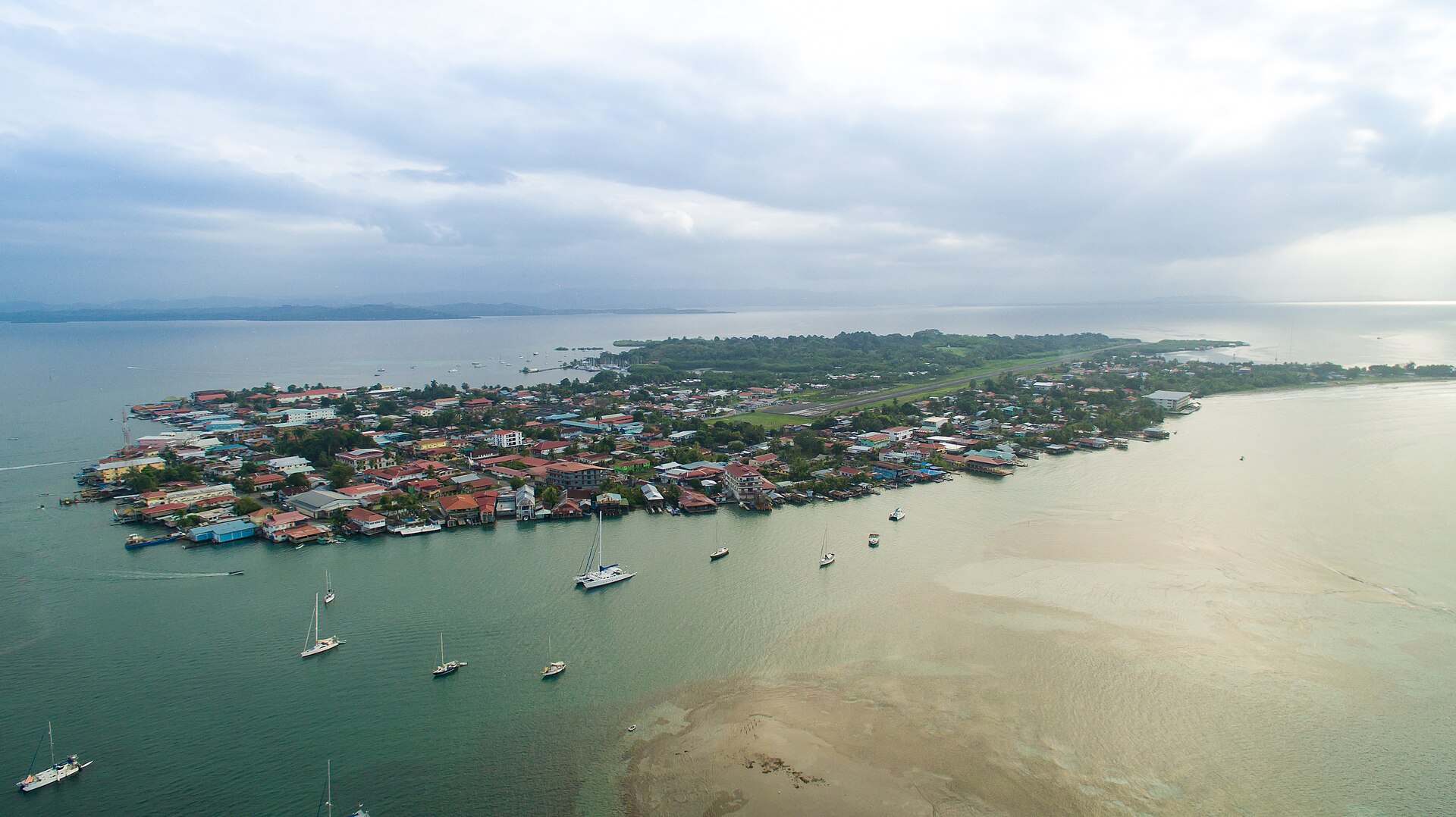
In Bocas del Toro, a non-resident foreigner can invest, but the first thing to check is not the price but the legal status of the lot. On the islands, art. 291 of the Constitution only allows island territory to be transferred for development purposes and under conditions, and in practice much of what is offered consists of derechos posesorios (possession rights) or 20-year renewable use concessions, not registered titles. On the mainland, the 10 km strip along the border with Costa Rica also applies, and it is off-limits to foreigners. Added to that are documented risks: the 2025 social crisis, with a suspension of constitutional guarantees, and about 15,000 people affected by floods in 2026 across the province and the Ngäbe Buglé comarca (indigenous territory). There are no verified price or yield data.
Data verified as of November 16, 2026.
What does the Constitution say about buying on an island?
Art. 291 of the current text of the Constitution states that island territory «may only be transferred for specific purposes of the country’s development», and under two conditions: that it is not a strategic area or one reserved for government programs, and that it has been declared a special development area with legislation on its use. Three nuances matter to an investor:
- It does not depend on nationality. The island rule applies to any buyer, Panamanian or foreign. The question is whether that specific lot is titled.
- Public-use property remains with the State even if the island is transferred: beaches and shorelines are not sold.
- Acquired rights are respected, but they can be expropriated at any time with adequate compensation.
A numbering warning: some online editions, such as Justia’s, publish this text as art. 286, with the numbering prior to the 2004 reform. The current number is 291, which is also used in the reservation lists of Panama’s trade agreements. You can read more in the guide on whether a foreigner can buy property in Panama.
Title, possession right or concession: the three situations
Art. 291 is implemented in practice through Law 80 of 2009 and Law 2 of 2006. In island territory, Law 80 only allows titling with possession of more than five years and for development purposes or in special development areas; in reserved areas, what is possible is a 20-year renewable use concession (arts. 13, 14 and 24). A title is also possible in areas declared by the Cabinet Council under Law 2 of 2006. A secondary source (ECOLEX/FAO) indicates that Law 23 of 2009 declared island territory a special development area; we did not verify whether it is still in force or whether Law 80 replaced it. For the details of buying a possession right in the archipelago, see buying in Bocas del Toro with possession rights.
| Status of the lot | What you have | Bank mortgage? | Main risk |
|---|---|---|---|
| Title registered at the Public Registry | Ownership with a folio real, enforceable against third parties | Possible | Liens or marginal notes: check the certificate |
| Possession right | A recognizable possession, not a title | No | Other possessors, mangrove or reserved area; uncertain titling |
| Use concession | A temporary 20-year right, renewable | No data | Renewal and State conditions |
Sources: Law 80 of 2009 · Law 2 of 2006 (ANATI) · Constitution, art. 291. Financing of concessions does not appear in the rate sheets consulted. Data verified as of November 16, 2026.
Other rules of Law 80 weigh heavily in the Caribbean. The beach strip on the Atlantic is 10 m from the high-tide line and, behind it, the coastal zone that can be granted extends to 190 m. Mangroves cannot be titled (art. 10). If the applicant for titling is a legal entity, it must disclose its ultimate beneficial owners (art. 11). And while a free title carries a marginal note, its transfer is void except to close relatives (art. 7.5). More detail in the guide to land and lots.
- 01Is there a folio real?Ask for the Public Registry certificate of ownership and liens. If it does not exist, it is not a title.
- 02What kind of area is it?Confirm whether the island or lot is a reserved area, a special development area or under a concession.
- 03Beach strip and mangroveLocate the 10 m beach strip and any mangrove on the survey plan: they cannot be titled.
- 04Distance to the borderOn the mainland, check that the lot is more than 10 km from Costa Rica.
- 05Independent lawyerDo not pay deposits for a possession right without a legal review of the file before ANATI.
Sources: Law 80 of 2009 · Constitution, arts. 258 and 291. Data verified as of November 16, 2026.
The border: Changuinola and the 10 km strip
Bocas del Toro borders Costa Rica. The same art. 291 prohibits foreign individuals, and Panamanian companies with foreign capital «in whole or in part», from acquiring land within 10 km of the borders. Unlike the island rule, this one does depend on nationality, and it cannot be avoided with a company. A possession right inside that strip can never be titled in the name of a foreigner.
Documented social and natural risks
The social security reform (Law 462, March 2025) triggered a banana workers’ strike in the province. Chiquita dismissed thousands of workers and, after one death and about 30 injured, the Government suspended the rights of assembly and free movement in Bocas del Toro for five days in June 2025, according to Al Jazeera and news agencies. For tourism investors, the episode shows that a social conflict can interrupt access and the arrival of visitors.
On the natural side, Sinaproc had responded to 527 floods nationwide in 2026 through September, and about 15,000 people were affected in Bocas del Toro and the Ngäbe Buglé comarca, according to Panamá América. We found no flood-risk maps by area or coastal erosion studies for the archipelago.
Sources: Al Jazeera · Panamá América · Public Prosecutor’s Office. Data verified as of November 16, 2026.
Tourism, rentals and pending incentives
According to the 2023 Census, the province has 159,228 inhabitants and 34,870 occupied private dwellings; it gained 33,767 inhabitants since 2010, 26.9% more (our own calculation). On tourism, the Tourism Authority only publishes national hotel occupancy (57–58% in 2025): there is no series for Bocas. Nor did we find verifiable lot prices, house prices or rental yields for the province, or the status of its airport.
There are two bills worth following, without counting on them. Tourism incentives Bill 31-26, introduced on September 15, 2026, proposes a 15-year exemption from income tax and property tax for lodging with a minimum investment of USD 500,000 in the Caribbean, in effect until 2036 (ATP); it is not in force. And another bill proposes a 15% ITBMS on short-stay tourist rentals in homes, compared with 10% for registered hotels; sources disagree on whether it is in Bill 713 or in 31-26, and there is no record of it being signed into law (Infobae). Model both scenarios in the rental yield calculator and read the guide to hotels and condo-hotels.
Two operating costs do have a source. Changuinola has the most expensive fuel of the locations on the official list published by the press: in the fortnight from October 30 to November 13, 2026, 95-octane gasoline cost B/.1.374 per liter, 91-octane B/.1.239 and diesel B/.1.588, about 5 cents more than in the capital (Telemetro, with Energy Secretariat data). And Bocas del Toro and Changuinola are in Region 1 of the 2026 minimum wage, the same as the capital (domestic service: B/.350 a month). For purchase costs, use the closing costs calculator; if you are seeking residency, check Which Panama visa is right for me?: the official sheet for the Pensionado (retiree) visa, for example, requires the property’s Public Registry certificate for the B/.100,000 exception, a document a possession right does not have.
To compare, see the guide to the best areas to invest in Panama, Chiriquí, which shares the border with Costa Rica, and Colón, the other Caribbean coast.
Frequently asked questions
Can a foreigner own an island or a lot on Isla Colón?
The island rule does not distinguish by nationality: a foreigner can hold a lot on an island if that lot is titled and registered under Law 80 of 2009 or Law 2 of 2006. If there is only a possession right or a concession, you will not have the same protection.
What is a 20-year use concession?
It is a temporary right that Law 80 of 2009 provides for in reserved island areas where land is not titled. It lasts 20 years and is renewable, but it is not ownership: when you buy, you acquire the right of use, not the land.
How much does a lot cost in Bocas del Toro?
We found no verifiable price data for the province. Any price should be weighed against the legal status of the lot, which on the islands matters more than location.
Are there already tax incentives for hotels in the Caribbean?
No. Bill 31-26 proposes a 15-year exemption for lodging with a minimum investment of USD 500,000 in the Caribbean, but as of November 16, 2026 it was not in force.
Is it safe to invest after the 2025 protests?
The data do not allow us to say yes or no. What is documented is that guarantees were suspended for five days in June 2025. Include it as a risk in your scenario, especially if your business depends on tourism.
Sources
- Political Constitution of Panama (Constitute Project)
- Law 80 of 2009 (Justia)
- ANATI: Law 2 of 2006 on tourism concessions
- ECOLEX: Law 23 of 2009 on island territory (secondary source)
- INEC: 2023 Census, population by province (Table 1)
- Al Jazeera: emergency in Bocas del Toro (June 21, 2025)
- Panamá América: Sinaproc has responded to 527 floods in 2026
- Public Prosecutor’s Office: Operation Huellas
- ATP: tourism incentives bill
- Infobae: proposed 15% ITBMS on tourist lodging (October 9, 2026)
- Telemetro: fuel prices from October 30 to November 13, 2026
This is general information, not legal, tax or financial advice. The prices quoted are asking figures and may not reflect closing values. Before buying, verify the title at the Public Registry (Registro Público) and consult a lawyer and a tax advisor licensed in Panama.

Milan Valdés Báez is an independent journalist and researcher based in Panama and the editor of Invest in Panama Real Estate, the real estate investment guide for foreigners. Every figure on the site is checked against official sources (the Official Gazette, the Superintendency of Banks, INEC, the National Migration Service and the Public Registry), with notes on which data have changed and which circulate out of date, and the guides and calculators are kept current. ORCID iD: 0009-0000-0112-3529.